“Media Tips for Babies and Toddlers” gives a good, brief overview of the babies-and-tv issue, with a few tips for older ages as well, courtesy of Commonsense Media.
TV for Babies
01 Jul 2011 Leave a comment
in Commentary, Disney, Infant Learning - 1st Three Years, Issues
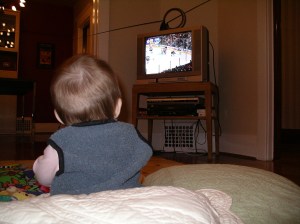
I’m wading into somewhat controversial territory here, but I just wanted to talk a bit about TV and babies…
There is a myth out there, an enormous behemoth of a myth, regarding babies and their brains. The myth incorporates concepts both uncontroversial (talking to your baby is good) and unsubstantiated (showing your baby the right video will make them smarter). The basic idea is that in the first three years of life important learning and brain formation is taking place and if capitalized upon in this crucial period, your baby will have a ‘leg up’ on learning later. Indeed, infancy may be such a ‘critical window’ that your child may not be able to learn certain things later if they don’t learn them right now. This is the basic premise that ensnares unwary parents, enticing them to buy all manner of products, books and videos, from baby sign language flash cards to early reader videos and classical music mobiles.
I’m not pointing the finger here – I too was hooked. I endeavoured to teach my baby sign language, though we got no further than “more” and “all done” for mealtimes, which was actually fairly useful. When I was slow to purchase a mobile for over the crib, I worried that I was losing valuable ‘enriched environment time’. And when I finally did acquire a mobile I congratulated myself on finding one that played classical music! So much better than childish jingles! I also fell prey to the Baby Einstein phenomenon. When my daughter was born everyone, and I mean everyone had these videos in their collection and we did too.
The reason that so many fall for this Big Myth and buy the products is that it targets the time right after birth, a time of maximum anxiety and minimum ability to do the research for ourselves. During pregnancy all thought and anxiety is placed upon the basic health of the mother, and looking ahead to childbirth. The books I had listed in excruciating detail every single little thing that could go wrong before and during birth. In the week-by-week guide I had they actually had a new health danger under every single week, just to spread the anxiety out over the entire gestation I suppose. At any rate I didn’t think much about baby’s first months before we were right into them.
And when the bundle of joy arrives is when things get really hectic. The lack of sleep and general weirdness of life with a new baby means that your focus narrows to just what is at hand. Crisis management. The only outside voices that cut through the haze and find their way into your brain are those that are giving you advice on parenting. And by ‘giving you advice’ I mean criticizing you. You have neither the time nor the energy to read deeply on any subject, never mind cutting-edge brain research. It is sufficient to glance at a headline telling you to ‘enrich’ baby’s environment as much as humanly possible. Or to play classical music to build up their brains. Or to expose them to foreign languages… even if you don’t speak them yourself. Parents are told they should:
“… make use of the windows of developmental opportunity nature has provided, applying a full-court developmental press every minute during the birth-to-3 developmental season. Failure to exert full-court pressure can have long-term consequences. …The implications are sufficiently dire to make most middle-class parents take notice. The advice provided is sufficiently vague to leave parents deeply uncertain and profoundly anxious about what they should do differently and about what does matter – other than everything – during the early years.” ¹
Doesn’t this sound painfully familiar? This type of advice puts the pressure on and gives you a deadline as well, asserting that by the time your child starts school, his best learning years are already over. If you miss the boat, it’s all over by age six.
Now the ‘experts’ have been telling parents what to do for a long time now. Thomas Cobbett in 1656 counselled parents to keep a “due distance” between themselves and their offspring, because “fondness and familiarity breeds and causeth contempt and irreverence in children.” ² From the ancient Greeks and onward through Locke, Rousseau, Freud, and Spock, the winds of philosophic fad and scientific fancy have blown parental advice back and forth for centuries, but the current pressure placed on the narrow time span of age zero to three is unprecedented.
And we swallow it, hook, line and sinker. Why wouldn’t we? In the first year of our child’s existence biological imperatives are running our lives: the desire to protect and care for our child is overwhelming, and intense love and hormones are turning us into crazy people who cry whenever a child is hurt on tv. (And don’t tv shows love to push that button!) So when newspapers or magazines or advertisers trumpet that the latest brain science says you should buy a black and white checkered dangly squeeze toy for your stroller, or you run the risk of lowering your child’s IQ… you do it!
The problem is that the actual research is habitually twisted by the media, advertisers, and lobby groups into convenient but inaccurate conclusions.
Do you remember hearing about research proving that classical music makes you smarter? This premise inspired state legislators in Georgia and Missouri to spend taxpayer dollars on classical CDs for newborns. It also provided the impetus for many Baby Einstein (and similar) products with a soundtrack of Beethoven, Bach or Mozart.
Classical music to make your baby smarter. A gorgeous idea. (And one that feeds brilliantly into Western middle class cultural snobbery.) Borne out by the research? Nope. The research that prompted all this had nothing to do with babies – it looked at how listening to Mozart affected the reasoning skills of college students… for periods up to ten minutes! Another study was of preschoolers given keyboard lessons and showing improvements in spatial reasoning for several hours. That’s it. Nothing about infant development at all.³
Beyond that, the research that is said to support the idea of an enriched environment for baby (the nursery as a jungle of vibrant eye candy), actually deals more with a normal environment being better than a deprived one. In other words, it’s not a good idea to raise your child in a dark closet with no stimulus, and not speak to him.
“Brain science has not pointed to new ways of raising or teaching children that will really stimulate those synapses above and beyond what normal experiences provide. … brain-based parenting amounts to doing no more than what most parents do normally.” ⁴
Which brings us to the issue of tv for babies. This is where things get personal, because everyone has their own thoughts on whether or not television is a blight on society or a saviour. You can go out and find a book to bolster whatever opinion you already have. Right here I am just going to go with my reactions, as they developed over time. In a nutshell:
1. Trying out a Baby Einstein video on my one-year-old: “YAY! She loves it! Thirty minutes of blessed freedom!”
2. “I am such a good parent. Listen to that classical music. She is going to be a genius!”
3. (this was the film student in me speaking): “Hmmm… the cutting in these is awfully quick.” (“Look, honey, that’s a… oh, it’s gone now. But it was a cow.”)
4. when she could spot the Baby Einstein logo from a mile away, and was drawn to it like a moth to a flame: “My baby’s been branded by Disney! Aaarrrghhh!” ⁵
Allow me to share with you some information gleaned later from a book that takes into account all the research done to date on children and television: The Elephant in the Living Room: Making Television Work for Your Kids, by Dimitri A. Christakis, and Frederick Zimmerman, published in 2006.
First, regarding the rapid cutting of tv shows:
“… attention (or thought while looking) deepens as a child looks at an object. Children usually take a few seconds to grasp an object visually before they can begin to think about it. … Careful experiments have shown that engagement reaches a maximum after about 20 seconds of looking at an object or a scene. Shorter looks are less likely to produce thoughtful looking and more likely to result in rapid distraction. In this sense, rapid scene changes on television can keep a child looking but not thinking.” ⁶
And, regarding Baby Einstein videos in particular, which can have cuts, or scene changes as frequently as every 4 seconds:
“… babies are transfixed by these videos, and the rapid scene changes are a big part of the reason … Young infants aren’t capable of understanding the content, and they don’t try to create a narrative from these images. For them, it isn’t a day on the farm at all; it’s just a series of stimuli coming at them full throttle. They will sit in front of the 30-minute feature not because they are interested in the content but because they are biologically programmed not to look away.” ⁷
They also point out that when an 18-month old looks at a book, they control the pace, and look at each page from 15 to 30 seconds on average. Whereas:
“… television shows change images every 7 to 8 seconds on average for educational shows … and every 3 to 4 seconds for noneducational shows… rapid scene changes may keep children’s focus, but they don’t allow them to devote their full attention to the scene.” ⁸
(I timed shot lengths for three Baby Einstein videos. Results at bottom of page.)
In the end Christakis and Zimmerman conclude that “you should avoid letting your children under 2 watch TV. There is no proven educational value at this age, and … there is considerable cause to be concerned about potential harm.” ⁹
This is not an isolated opinion. In fact, the American Academy of Pediatrics offered this recommendation five years earlier, in 2001:
“Discourage television viewing for children younger than 2 years, and encourage more interactive activities that will promote proper brain development, such as talking, playing, singing, and reading together.” ¹⁰
Indeed, this recommendation provided the backbone for an ongoing battle between Baby Einstein and researchers (including Christakis) regarding the products’ educational claims.
Most recently: “Baby Einstein Creators Challenge Research Anew”¹¹
So in the end I feel that it might have been better not to turn on the tv at all until she turned two, but I’m not overly concerned. The thing to remember, I think, is that the zero to 3 age range is not as ultra-crucial as we’ve been led to believe. Infants take in all stimuli, good bad and indifferent, and learning continues on… even into adulthood (!). There are no critical windows slamming shut on your child’s third birthday.
Above all, if the information here (or elsewhere) makes you feel like you’ve been doing everything terribly wrong for your infant’s brain development, as long as you haven’t kept your baby in a sensory deprivation situation, just take a deep breath and repeat after me: “Brain plasticity. Brain plasticity. Brain plasticity.”
(And when my child does turn out to be a genius, I’m going to attribute it to her efforts, not Baby Einstein‘s, and not mine!)
_____________________________________
¹ John T. Bruer. The Myth of the First Three Years: A New Understanding of Early Brain Development and Lifelong Learning (New York: The Free Press, 1999) p. 17
² Colin Heywood. A History of Childhood (Cambridge: Polity Press, 2001) p. 85
³ Op. cit. Bruer, p. 63
⁴ Ibid., p. 66
⁵ Disney purchased 80% of the Baby Einstein company in 2001.
⁶ Dimitri A. Christakis and Frederick J. Zimmerman. The Elephant in the Living Room: Making Television Work for Your Kids. (New York: Rodale, 2006) p. 19
⁷ Ibid., p. 23
⁸ Ibid., p. 27
⁹ Ibid., p. 34
¹⁰ American Academy of Pediatrics, Committee on Public Education (February 2001). “Children, Adolescents, and Television (policy statement)”. Pediatrics 107 (2): 423–426. doi:10.1542/peds.107.2.423. PMID 11158483.
¹¹Donna Gordon, “Baby Einstein Creators Challenge Research Anew”, Associated Press, Seattle, June 30, 2011, accessed July 1, 2011, 8:00 AM.
________________________________________
Now back to Baby Einstein and the pacing of the edits. I did a little timing myself and found the following:
the original BABY EINSTEIN, aka LANGUAGE NURSERY, 1997
Video of the Year Winner – Parenting Magazine
“Visual and multilingual experiences to stimulate and delight your baby”
26:11 long (body of film, excluding head and tail credits)
72 cuts
average shot length: 21.8 SECONDS
Still shots of toys (nothing moving) are consistently 7 seconds long.
Shots with camera movement or toy movement are longer.
Motherly voices saying children’s rhymes, counting, etc. in various languages.
Short promotional video afterward emphasizes that this video will not teach child to speak foreign languages… “what the soundtrack will do is stimulate portions of your baby’s brain that are largely ignored. Research indicates that babies are born with the ability to respond to, and to produce, any sound. By six months of age this ability begins to fade as the child hears only one language, and by 12 months the ability is gone. So it’s pretty simple. BE is a unique means of stimulating your child’s brain during the critical first years of life. The natural window of opportunity…” is 1-12 months of age.
What the research actually indicates is that babies learn to differentiate between subtle sounds made in their own language and not in others. This ability can be learned later – it does not simply disappear at 12 months.
——————————————–
BABY MOZART; Music Festival, 2004?
“A vibrant, award-winning musical feast for little eyes and ears”
24:57
92 cuts
average shot length: 16.3 SECONDS
Still shots are now only 4 seconds each, though stills of animals are as long as 9 seconds.
Longest shots are generally :30, though there is one dizzying 50 second stare at a lava lamp. (Totally justified, in my opinion.)
More closeups in this one – wide shots, then cut close. These tend to be 20 seconds each.
Series of moving toys: 10 seconds each.
At the end there is a very fast sequence of moving toys, each shot is 3-4 seconds long.
Promotional short at end is much more cautious at this point, and does not mention brain stimulation. Videos are claimed to be suitable for infants from birth onward. Creator says “the most important thing we’ve done is to encourage parents to interact…” – never mind that the vast majority put the video on so they can leave the room and get something done!
While promoting the extra merchandise now available, they exult that “Baby Einstein can be there all day long!” Yikes.
——————————————–
BABY BEETHOVEN; Symphony of Fun, 1999/2009
“Visual treats and musical masterpieces to stimulate and delight your baby”
24:34
118 cuts
average shot length: 12.5 SECONDS
Stills of baby faces are held for 6 seconds each.
Scenes of kids interacting with toys – 8 seconds each.
Reluctance to sit on a wide shot – many pans, zooms, cutting to different angles on the same toy (could be confusing).
Cutting to the music at times, which sacrifices shot length.
Promotional short: “Probably the most important thing that we’ve done is to encourage parents to sit with their children, to interact with their children, to dance with their children.” De-emphasizing educational claims, now merely claiming to expose your baby to art, music, science (?) etc. Plus the strange claim that they have “reorchestrated” Beethoven “in a way that is appealing to babies’ ears”.
Fairy Tale Controversy, Part 3: Modern Times
17 Jun 2011 Leave a comment
in Books, Classics, Commentary, Disney, Gender Differences, Issues, Violence Tags: Fairy Tale

[Previously: Fairy Tale Controversy, Part 1 ; Fairy Tale Controversy, Part 2: Coming to America]
Fairy tales are no less controversial today than they ever were in the past. The arguments against them echo some of the concerns of the past, and add new ones. Sexual content or innuendo in tales for children is still prohibited. We are less concerned about maintaining class distinctions, but we definitely have a lower tolerance for grisly violence than audiences of the past. And we have added the relatively recent concerns of racism and sexism to the mix. As well, parents today seem inordinately bothered by death scenes in children’s literature. In past times, the death of a parent, of a mother in childbirth, of babies and young children was much more common than today, and therefore found a place in the literature. Today we seem uneasy with the very subject, a modern preoccupation.
Watching Old Movies
27 May 2011 Leave a comment
in Advertising and Consumerism, Commentary, Issues, Movies, Old Movies, Silent Movies, Violence
Wouldn’t it be pleasant to sit down and watch a movie with your kids that wasn’t presold on sequels and Happy Meals? Or take them to an action movie that didn’t either freak them out or weigh down their little bones with premature irony? – Ty Burr, The Best Old Movies for Families
When I talk about Old Movies I don’t mean going back to Toy Story 1, or even aaall the way back to the first Star Wars (though 1977 does seem long, long ago in a galaxy far far away)… I’m talking about Oooooold movies here.
You may not have any interest in old movies, indeed, I realize not everyone has spent a lifetime loving them like I have. But if you are old enough to be a parent, you are certainly aware of how much movies have changed since the flicks you watched as a kid. They’ve changed for the better, in terms of technology. The complex visual and sound effects of modern movies absolutely boggles the mind. (Just compare a Harryhausen Sinbad movie to Avatar!) And they’ve also changed for the worse… can you even imagine a world in which there were no teen slasher horror films?
Whether or not you know much about old movies, when it comes to picking films for family movie nights, there are many good reasons to turn to the oldies…
Know Your Movie Ratings
20 May 2011 Leave a comment
in Commentary, Issues, Movies, Violence
A few words on Movie Ratings…
The Motion Picture Association of America (MPAA) selects the familiar G, PG, PG-13, R, and NC-17 ratings for motion pictures.
It is important to fully understand these ratings and their drawbacks, however, before relying too heavily on them.
The Serpent Slayer; and Other Stories of Strong Women
16 May 2011 Leave a comment
in Books, books 5+, Gender Differences Tags: adventure, Fairy Tale, folktales, pirates, Princess, strong girls
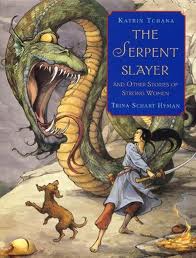
retold by Katrin Tchana
illustrations by Trina Schart Hyman
Boston: Little, Brown and Company, 2000
109 pp. – each individual story averages about 6 pages
Age: 5 + (some stories suitable for 4)
Interests: folk tales, princesses, pirates, fairy tales, magic, other cultures
Other books by this illustrator: St. George and the Dragon, Rapunzel
Very Interesting Data on the Vocabulary of Toy Advertisements
19 Apr 2011 Leave a comment
in Advertising and Consumerism, Gender Differences, Issues
From “The Achilles Effect”, a terrific set of visualized data:
Word Cloud: How Toy Ad Vocabulary Reinforces Gender Stereotypes
There are two fascinating word clouds, one for boys and one for girls.
(Click MORE if you don’t mind hearing me rant a little…)
A study of Violence in G-rated Animated Feature Films!
17 Apr 2011 Leave a comment
Maybe I’m a total geek but I found this very exciting, even though it’s over 10 years old. First I found a reference to the study in this book:
The Elephant in the Living Room: Make Television Work for Your Kids, by Dimitri A. Christakis and Frederick J. Zimmerman (New York: Rodale, 2006),
and then I found the actual study online:
Yokota, F. & Thompson, K. M. “Violence in G-rated Animated Films” in the Journal of the American Medical Association 283 (May 24-31, 2000): 2716-2720. (see the full study here)
It covers animated films of feature length (at least 60 min.) that were rated G, released theatrically in the U.S. and which were “available for review on videocassette” by September of 1999, including 74 titles.


 Rarest Kind of Best
The Thing About Disney…
08 Jul 2011 Leave a comment
by Kim in Advertising and Consumerism, Commentary, Disney, Issues
“It doesn’t matter whether it comes in by cable, telephone lines, computer or satellite. Everyone’s going to have to deal with Disney.” – Michael Eisner, former Disney CEO
Oh, Disney, Disney, Disney… You simply cannot be a parent today and not have an opinion on it. Some of us love Disney, some of us hate Disney. (Some hate it so much that they try to ban Disney product entirely from their children’s lives, though I’m not sure this is the right way to go… even if it was possible… which it isn’t.) Many, many of us love and hate Disney at the same time.
The hate is well deserved. Disney the Corporation has set new standards for rapacious capitalism. Its aggressive marketing is impossible to escape – the vast resources of the conglomerate can easily clobber us into submission. And the shameless nature of the conglomerate allows it to do the clobbering without hesitation. Disney product is promoted so relentlessly that it’s well-nigh impossible to escape it. Your child doesn’t even have to see the latest movie or tv show to be intimately acquainted with every character – their friends will be wearing the underwear, T-shirts, hats and socks, carrying the backpacks and lunch boxes, and will eagerly fill them in on the details. You can have a TV-less, computer-less home off the grid in the back forty of nowhere, but around the age of three your daughter will – as if by magic – know exactly what colour of dress each Disney princess wears.
Okay, so that’s the ‘hate’ part of the relationship. How about the ‘love’?
Like it or not, especially when you go back to the early films, Snow White, Pinocchio and onward, the sheer quality of them is outstanding. Walt singlehandedly invented the genre of feature-length animated family film, and set such high technical and artistic standards that other companies are still scrambling to keep pace. He personally insisted on such perfection and care on his films in the early days, often taking huge financial risks to do so, that he was able to create the sterling reputation for his company that allowed it to survive many a storm over the decades and grow to the behemoth it is today.
I still appreciate that he cared enough, and spent the time and money to make very high-quality entertainment for children.
Many of his films (and again, I tend to prefer the older ones) are cinematic treasures, part of our cultural language. Artistically and technically his films are great accomplishments, but Walt’s real talent lay in his instinctive knack for giving the American public exactly what it wanted and needed, exactly when it wanted and needed it the most.
“Walt Disney operated not only as an entertainer but as a historical mediator. His creations helped Americans come to terms with the unsettling transformations of the twentieth century. This role was unintentional but decisive.” – Steven Watts The Magic Kingdom ¹
In every way Disney was able to perfectly dovetail the fortunes of his company with the tastes and values of mid-twentieth century American culture, most especially in its concerns about children. The young nation was eager to carve out its own character and culture in contrast to that of Britain and Europe, and America’s anxieties about modernity – industrialism, urbanism, immigration, overcrowding and social unrest, the declining influence of the church – all came to the forefront in debates about how best to raise the next generation of good American middle-class citizens.
“As mass consumer culture increasingly came into conflict with an ideal American culture, the child became the focal point in the struggle to preserve those American ideals and enforce their inclusion in mass-mediated products.” ³
Science provided new tools of psychiatry and data research to analyze family life, and the business of parenting advice literature boomed.
“… in a very real sense twentieth-century child-rearing manuals may also be read as manuals for entering the middle class.” ⁴
Disney’s singular success was due to instinct and strategy but also to dumb luck and demographics. Just as he was aligning his product with what was popularly thought to be beneficial for children, between 1940 and 1965 the number of children in the U.S. aged five to fourteen doubled.⁵ Parents grew to trust movies and books with the Disney logo unquestioningly. Disney had achieved “brand recognition that did not require assessment of individual products.” ⁶ This frankly brilliant positioning persists to the present day, as parents make assumptions about Disney excellence despite wildly inconsistent product: badly written books, merchandise that falls apart as soon as you buy it, and knock-off subsidiary videos (ie. Sing-Along series) with incredibly inept, off-model animation. Apparently total market dominance requires more than a few corners to be cut.
Indeed, everyone has to deal with Disney. It has the power to compel one’s attention to any product it wants to push:
“All its parts – movies, television, book and song publishing, merchandising, Disneyland – interlock and are mutually reciprocating. And all of them are aimed at the most vulnerable portion of the adult’s psyche – his feelings for his children. If you have a child, you cannot escape a Disney character or story even if you loathe it. … The machine’s voice is so pervasive and persuasive that it forces first the child, then the parent to pay it heed – and money. In essence, Disney’s machine was designed to shatter the two most valuable things about childhood – its secrets and its silences – thus forcing everyone to share the same formative dreams. … As capitalism, it is a work of genius; as culture, it is mostly a horror.” ⁷
That’s the ‘hate’ side of the coin, certainly, and while I agree with much of what Schickel has to say, I still find a surprising spark of fondness in my cynical brain for individual movies, scenes and characters, if not for the twelve tons of crappy plastic toys that accompany them.
I may wince from time to time, raise an eyebrow at Disney excess, or resist buying everything they push at me, but my daughter and I will continue to watch the films. I’ll try to address issues as they crop up – consumerism, racial insensitivity, sexism, body image issues, and the general blinders-on limited vision of society – but I’m not going to deny my little girl the accomplished, beautiful and funny movies that give her so much delight.
Everyone has to deal with Disney – she is her own person and she will deal with Disney on her own terms as she grows up, just as I have tried to do.
_____________________________
¹ as quoted in Nicholas Sammond, Babes in Tomorrowland: Walt Disney and the Making of the American Child, 1930-1960 (Durham/London: Duke University Press, 2005) p. 13
² Richard Schickel, The Disney Version: the Life, Times, Art and Commerce of Walt Disney (Revised and Updated) (New York: Touchstone/Simon & Schuster, 1968/1985) p. 30
³ Op. cit. Sammond, p. 7
⁴ Ibid., p. 7
⁵ Op. cit. Schickel, p. 19
⁶ Op. cit. Sammond, p. 74
⁷ Op. cit. Schickel, p. 18